Ordinary Citizens, Extraordinary Change: The Neighborhood Leaders Redefining What Community Means
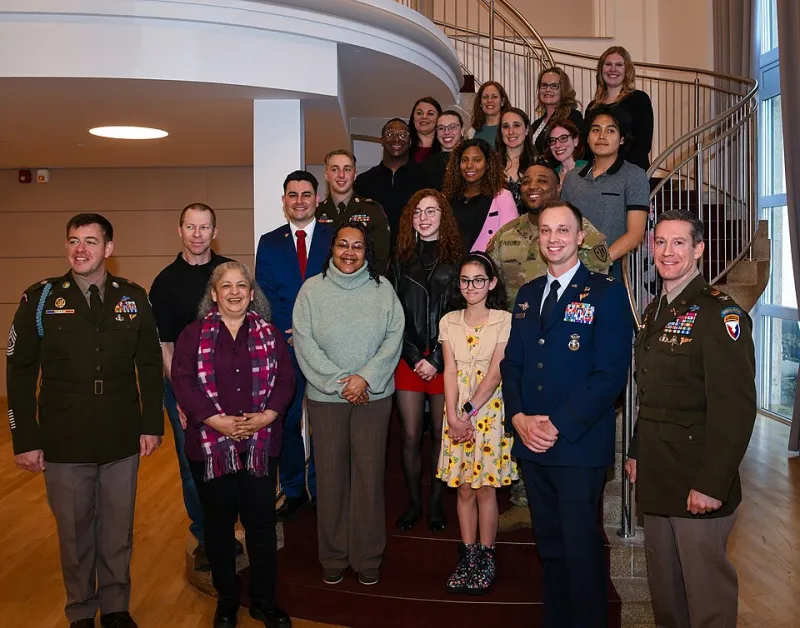
Photo: U.S. Army USAG-RP by Spc. Matthew Poe, Public domain, via Wikimedia Commons
There is a particular kind of courage required to look at a broken system and decide, quietly and without fanfare, that you will be the one to fix it. Not a politician. Not a celebrity philanthropist. Just a neighbor, a parent, a former student — someone who has lived inside the problem long enough to understand its contours.
Across the United States, these individuals are emerging in growing numbers. They are not waiting for institutional permission. They are starting food pantries out of church basements, organizing youth programs in school parking lots, and building mentorship networks through text message threads. And in doing so, they are demonstrating something that Fundación SM has long believed: that sustainable social change begins at the street level, with people who have the most at stake.
The following profiles represent a cross-section of this quiet revolution — four community members who began with a single act of service and grew it into something far more enduring.
From a Single Pot of Soup to a Regional Food Network
When Mariela Orozco began cooking large batches of pozole in her Detroit kitchen in 2019, she had one goal: to feed the families on her block who were struggling after a wave of factory closures. She distributed containers from the trunk of her car on Friday evenings. Within eight weeks, she had more volunteers than she could coordinate and more families requesting meals than she could serve alone.
Rather than scale back, Orozco enrolled in a free nonprofit management course offered through her local community college. She registered her effort as a 501(c)(3), recruited a board of directors from among her volunteers, and began approaching local restaurants and grocery chains for surplus food donations. Today, her organization — Raíces Fuertes Community Kitchen — serves more than 400 households weekly across three Detroit neighborhoods, employs four part-time staff members, and has begun training other community members to replicate the model in adjacent zip codes.
"The hardest part was not the cooking," Orozco has said. "It was learning to trust other people with something I had built with my own hands. But that is the only way it grows."
Her experience underscores a critical insight for aspiring civic leaders: scalability requires the willingness to share ownership. Organizations that remain tightly controlled by a single founder often plateau. Those that distribute leadership tend to multiply.
A Mentorship Program Born from Personal Loss
Marcus Webb grew up in Chicago's South Side and lost two childhood friends to gun violence before the age of twenty. For years, he channeled his grief into his career as a high school basketball coach. But in 2017, when a student he had mentored informally was arrested, Webb recognized that coaching alone was insufficient. Young men in his community needed sustained, structured relationships with adults who understood their environment.
He launched Bridge & Beyond with a single Saturday session in his school's gymnasium — eight young men, a whiteboard, and a conversation about futures. Within eighteen months, the program had formalized a twelve-week curriculum covering financial literacy, conflict resolution, and career exploration. Webb partnered with local employers to offer job shadowing opportunities and connected with a Chicago-based legal aid organization to provide workshops on navigating the justice system.
Today, Bridge & Beyond has served more than 600 young men and has been adopted as a supplementary program by three Chicago public high schools. Webb credits his growth not to any single grant or partnership, but to the discipline of documentation. "From the very beginning, I wrote everything down — what worked, what failed, what the young men responded to. That record became our curriculum. It became proof that we knew what we were doing."
For those considering similar initiatives, Webb's approach offers a clear directive: treat your early efforts as research. Rigorous self-evaluation is the foundation upon which credibility — and funding — are built.
Turning an Empty Lot into a Living Classroom
In Albuquerque, New Mexico, a vacant lot on the corner of a residential block sat overgrown and unused for nearly a decade. For Rosa Tafoya, a retired schoolteacher and lifelong gardener, it represented not blight but potential. After negotiating a long-term lease agreement with the city, she organized a weekend cleanup and planted the first seeds of what would become the Tierra Viva Community Garden.
What began as a neighborhood beautification project evolved into a comprehensive food education program. Tafoya partnered with the local school district to bring elementary students to the garden for science lessons. She collaborated with a registered dietitian to offer free cooking demonstrations using produce harvested on-site. She established a sliding-scale plot rental system so that low-income families could grow their own food at minimal cost.
The garden now hosts more than 80 active plots, a seed library, and a youth agricultural internship program that pays stipends to high school participants. Tafoya's model has been recognized by the New Mexico Department of Agriculture as a replicable community food security initiative.
Her advice to new community organizers is disarmingly simple: "Start with what is already there. The land was there. The neighbors were there. The need was there. I just made a space where all three could meet."
Digital Access as a Civil Rights Issue
When the COVID-19 pandemic forced schools online in 2020, Darnell Hughes, a network technician in Philadelphia, watched his niece fall behind in her studies because the family's apartment lacked reliable internet access. Recognizing that this was not an isolated problem but a systemic one, he began collecting donated laptops and refurbishing them in his garage.
Within months, Hughes had distributed more than 150 devices to families in his West Philadelphia neighborhood. He then partnered with a local internet service provider to negotiate discounted connectivity plans for low-income households and trained community members as basic tech support volunteers. His initiative, ConnectED Philly, has since distributed over 2,000 refurbished devices and helped more than 800 families access subsidized broadband.
Hughes has now begun advocating at the municipal level for sustained digital equity funding, bringing the voice of lived experience into conversations that have long been dominated by corporate and governmental stakeholders.
"Technology is not a luxury," he has stated before Philadelphia City Council. "It is infrastructure. And infrastructure should be equitable."
What These Stories Share
Across these four narratives, certain patterns emerge with striking consistency. Each leader began with a deeply personal connection to the problem they sought to address. Each invested in learning — whether through formal coursework, peer networks, or rigorous self-documentation. And each, at a critical juncture, chose to expand their circle of trust rather than maintain sole control.
These are not exceptional people in the sense of being born with unusual gifts. They are exceptional in the sense of having made an exceptional commitment — to their neighbors, to their communities, and to the belief that proximity to a problem is itself a form of expertise.
At Fundación SM, we believe that supporting these leaders is among the most consequential investments a philanthropic organization can make. The solutions they build are not imported from outside; they are grown from within. And that, more often than not, is what makes them last.
If you are ready to move from volunteer to impact leader, or if you wish to support those who are, we invite you to explore the community programs and giving opportunities available through Fundación SM. Building communities begins with recognizing the builders already in your midst.